Why 710 BWP Plywood Delaminates in Coastal Kerala & How Co-Extruded 3-Core Solved It
Even genuine 710 Boiling Water Proof marine plywood faces core veneer rot and fungus under 90%+ coastal Kerala humidity. Here is how co-extruded 3-layer WPC technology withstands backwater salinity and coastal monsoons.
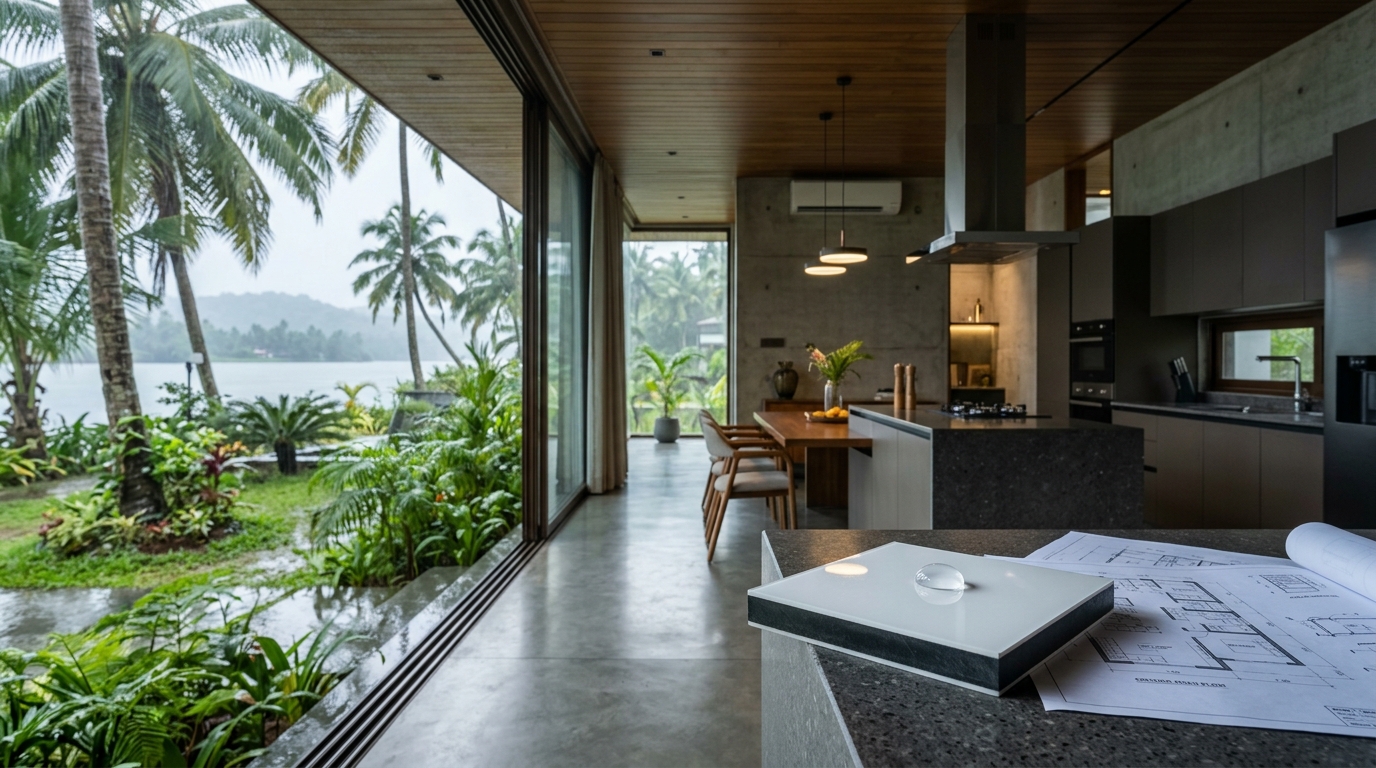
Kerala's coastal geography is an architectural paradox. The same breathtaking environment that inspires backwater villas in Alappuzha, beachside residences in Calicut, and waterfront penthouses in Kochi also creates one of the most punishing microclimates on the planet for building materials.
With ambient relative humidity consistently hovering between 85% and 98% throughout the southwest monsoon, and airborne marine salinity penetrating deep into interior partitions, traditional timber boards undergo non-stop thermodynamic stress.
Yet, countless contractors still default to specifications reading: "All modular cabinetry to be executed in 18mm BWP IS:710 Marine Plywood." Fast-forward four years, and the results are predictable: delaminated door edges, bubbling laminates, pungent fungal odor in closed wardrobes, and subterranean termite colonization. Why does even certified 710 marine plywood fail—and why is 3-layer co-extrusion changing coastal architecture?
1. The Science of Plywood Delamination in Humid Microclimates
To understand why marine plywood fails in Kerala, one must understand how standard IS:710 plywood is constructed:
Plywood is an alternating sandwich of peeled timber veneers bonded under heat and pressure using Phenol Formaldehyde (PF) synthetic resin. The certification test for BWP requires test samples to withstand 72 hours in boiling water without veneer separation.
Here is the hidden catch: The glue line is waterproof, but the wood veneers are not.
- Hygroscopic Veneer Expansion: Natural timber is inherently porous. Even when saturated with resin, the inner core veneers absorb atmospheric water vapor, expanding across the grain. Over 3–5 monsoon cycles, this repeated expansion and contraction induces microscopic shear fatigue along the glue lines.
- Adhesive Hydrolysis: When standard laminates (Mica) are pressed onto plywood with water-based PVA adhesives (white glue), high coastal humidity slows curing and promotes microbial hydrolysis, causing the decorative laminate to bubble and peel away.
- Internal Anaerobic Decay: Water trapped inside the closed core of marine ply under a warm coastal climate (28°C–34°C) creates the perfect incubator for wood-decay fungi and black mold, destroying the material from the inside out.
2. Enter 3-Core Co-Extrusion: A Multi-Layer Solution
Standard homogeneous boards (single-layer PVC or WPC) have a uniform texture. However, coastal environments require two conflicting performance traits: extreme surface hardness to resist scratches and moisture ingress, and a dense shock-absorbing core to resist impact and hold screws securely.
This led to the development of WALLPEX 3CORE, produced using co-extrusion die technology where three distinct layers fuse simultaneously in a single continuous manufacturing run:
The Anatomy of a Co-Extruded Board:
High-gloss, ultra-dense, UV-stabilized white surface with zero porosity. Completely hydrophobic—water beads up and rolls off without surface penetration.
Densely compacted composite core engineered to provide dimensional stability, screw grip, and flexural dampening.
Mirrors the top protective armor to equalize thermal expansion stresses, guaranteeing zero warping across changing seasonal temperatures.
3. The Zero-Laminate Advantage: Saving Time and Failure Points
In traditional plywood modular kitchens, fabricators must purchase raw marine plywood, buy separate 0.8mm or 1.0mm white laminates for the internal carcass, apply adhesive, press the sheets for 24 hours, and manually edge-band every single seam.
With Wallpex 3-Core (Order Sample Specimen), the mirror-finish white glossy surface is already co-extruded onto the board at the factory.
What this means for a Kochi or Trivandrum site:
- No adhesive failure risk: Because there is no glue line between the core and the surface, delamination is physically impossible.
- 40% faster fabrication timeline: No waiting for laminate pressing. The board is cut, edge-banded, and assembled straight from the crate.
- 100% Saline resistant: Salt spray from coastal winds cannot corrode or dull the virgin polymer skin.
- Zero VOC off-gassing: Completely free of formaldehyde, lead, and volatile organic compounds that degrade coastal indoor air quality.
Architectural Takeaway for Kerala Interiors
In coastal architecture, moisture resistance cannot be an afterthought treated with surface varnishes or laminate veneers. Materials must be innately non-hygroscopic. For interior carcasses in high-humidity zones—kitchen sink units, coastal bathroom vanities, open patio bars, and backwater villa wardrobes—co-extruded 3-core composite boards eliminate the recurring cycle of monsoon swelling, giving clients spaces built to endure coastal nature.
Engineering Confidence for Your Next Project.
Designing a luxury residence, waterfront villa, or commercial modular interior? Specify genuine 0.70 high-density WPC and 3-Core co-extruded boards to eliminate water swelling, rot, and termite failure permanently.
Engineered Boards Mentioned in this Article
WALLPEX ELITE
Flagship high-density wood polymer composite board for heavy-duty cabinetry & wet zones.
WALLPEX 3CORE
3-layer co-extrusion with factory glossy white surface—zero laminate pressing needed.
WALLPEX PRO
High-grade architectural PVC foam board for CNC routing, ceilings, and partitions.