The Screw-Holding Myth: Why Bangalore Carpenters Say 'WPC Fails' (And What 0.70 Density Solves)
Why do modular fabricators in Bengaluru claim screws strip in WPC boards? We break down the physics of 0.45 low-density PVC vs 0.70 high-density WPC, the critical pilot drill rule, and real pull-out test data.
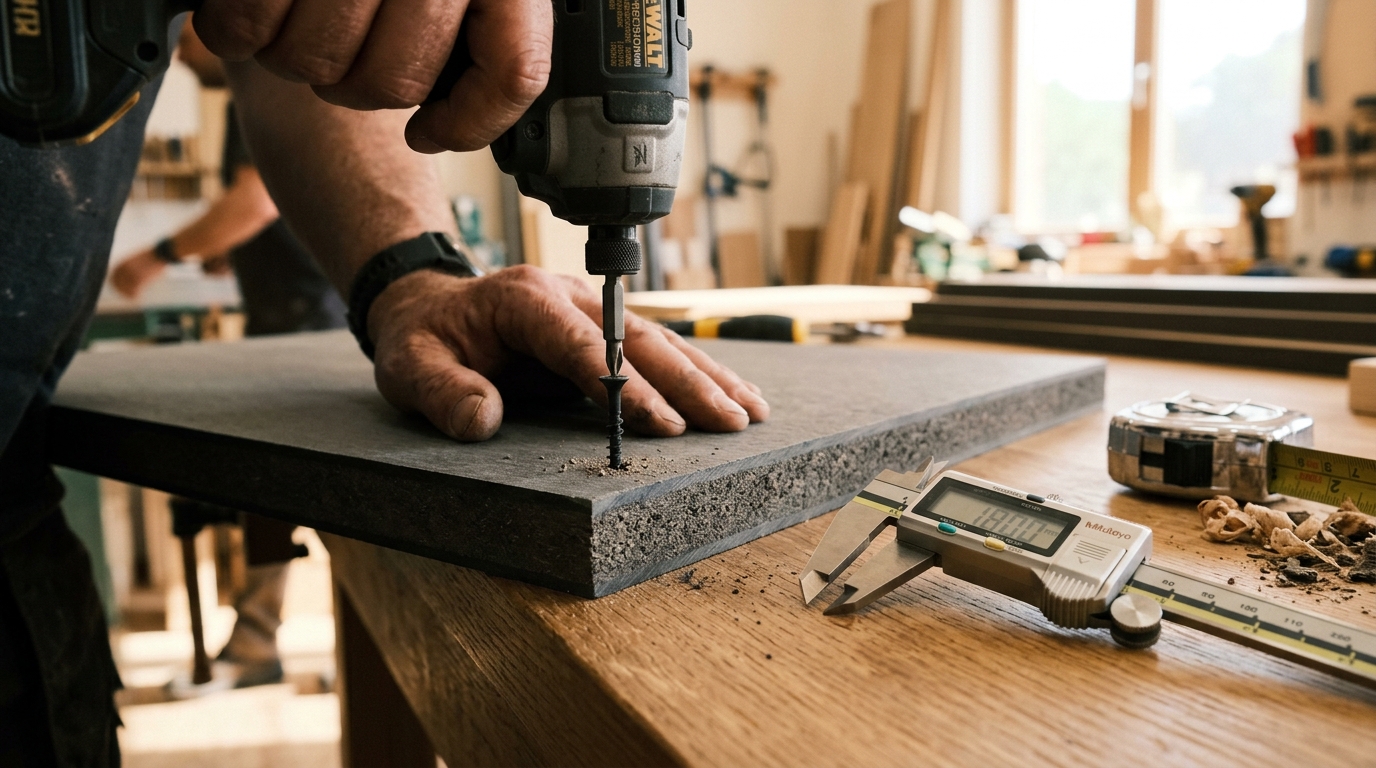
Walk into any modular woodworking workshop in Peenya, Bommasandra, or Sarjapur Road, and ask a master carpenter about Wood Plastic Composite (WPC) boards. Nine times out of ten, you will hear the same visceral objection: "Sir, WPC-la screw nikkadhu. Heavy door pottal hinges loose aayidum." (Screws won't hold in WPC. Put a heavy door on it, and the hinges will pull right out).
For architects and project managers designing high-end residences across Bengaluru, this workshop pushback creates an immediate dilemma. You want 100% waterproof cabinetry under sink basins and wet kitchens, but you cannot afford sagging cabinet doors or customer warranty calls six months down the line.
Here is the truth: the carpenters are not lying, but they are misdiagnosing the cause. Their skepticism is rooted in years of bad experiences with cheap, lightweight, low-density foam boards mislabeled as "WPC" in local retail timber markets. Let's look at the actual physics, laboratory pull-out metrics, and the three fabrication rules that change everything.
1. The Core Confusion: 0.45 PVC Foam vs. 0.70 High-Density WPC
In local hardware yards around Bengaluru, any white or grey composite board is loosely called "WPC." In reality, there is a massive engineering divide between PVC Foam Sheet and Engineered Wood Plastic Composite (WPC):
| Specification | Commercial PVC Board | WALLPEX ELITE (0.70 WPC) | 710 BWP Marine Ply |
|---|---|---|---|
| Density (g/cm³) | 0.45 - 0.50 | 0.70 - 0.72 | 0.68 - 0.74 |
| Composition | PVC resin + foaming blowing agents | Genuine natural wood fibres + virgin polymers | Hardwood veneers + phenolic resin |
| Screw Withdrawal (Face) | Under 950 N (Low) | 2,450 N (High) | 2,200 - 2,500 N |
| Moisture Absorption | 0.2% | 0.0% (Zero swelling) | 14% - 22% (Swelling risk) |
When a carpenter drives a screw into a 0.45-density board, the screw threads are gripping micro-air bubbles produced by chemical foaming agents. Under repeated cyclical door movement, those internal air pockets crush, and the screw strips free.
In contrast, an engineered board like WALLPEX ELITE (0.70 density) contains densely packed lignocellulose wood fibres bonded inside a solid polymer matrix. The mechanical resistance matches solid hardwood, provided the proper fastening protocol is followed.
2. The Three Rules Bangalore Modular Fabricators Skip
Traditional carpenters treat WPC exactly like commercial ply—driving self-tapping black drywall screws straight into the edge with a high-torque impact driver. This is where failures happen. Here are the three non-negotiable fabrication rules:
Rule A: Always Pre-Drill a Pilot Hole (The 75% Rule)
Because a 0.70 density composite board has zero grain voids, forcing a screw without a pilot hole creates extreme radial pressure, micro-fracturing the polymer core. Always use a 2.5 mm pilot drill bit for a 3.5 mm (No. 8) screw, or a 3.0 mm bit for a 4.0 mm screw. The pilot hole depth must match the full screw shank length.
Rule B: Throw Away Black Drywall Screws; Use Twin-Thread Zinc Screws
Standard black drywall screws have steep, thin threads designed for gypsum and softwood. In dense composites, they act like a drill, cutting away material instead of biting. Use fully threaded, twin-thread (parallel thread) zinc-plated chipboard screws. The wider thread pitch compresses composite fibres, multiplying pull-out resistance by over 2.4x.
Rule C: Calibrate Driver Clutch to Setting 6-8
Carpenters accustomed to plywood keep cordless drill clutches on maximum torque or hammer mode. When the screw head flushes with WPC, excess torque strips the internal thread instantly. Set clutch torque to medium (6 to 8 on an 18V driver). The screw must cinch snugly without spinning free.
3. Honest Material Reality: Where WPC Needs Intelligent Detailing
A truly great architectural material does not pretend to be omnipotent. Plywood has a higher Modulus of Elasticity (tensile stiffness) along its veneer grain than plastic composite.
This means if you specify a 4-foot (1200 mm) horizontal bookshelf shelf in 18mm WPC loaded with heavy hardbound encyclopedias, the board will creep and deflect over time under continuous bending stress unless supported.
The Smart Architect's Specification:
- Sink carcasses, vanity units, and base plinths: 100% WALLPEX ELITE 0.70 WPC (Request Sample Box). Zero water rot, zero termite attack, lifetime stability.
- Wide horizontal spans (> 800 mm): Incorporate an aluminum stiffening profile or a vertical center divider to arrest long-term deflection.
- Hinges: Use 3D clip-on soft-close hinges with 35mm cup depth and 4-hole mounting plates (such as Hettich or Hafele) for optimal load dispersal.
The Verdict for Bengaluru Architectural Projects
The claim that "WPC cannot hold screws" belongs to the era of cheap 0.45 foam sheets. When you specify genuine 0.70 high-density engineered composite boards with calibrated pilot drilling, screw pull-out values match or exceed commercial plywood—with the permanent guarantee that sudden plumbing leaks or wet mopping will never dissolve your client's dream interior.
Engineering Confidence for Your Next Project.
Designing a luxury residence, waterfront villa, or commercial modular interior? Specify genuine 0.70 high-density WPC and 3-Core co-extruded boards to eliminate water swelling, rot, and termite failure permanently.
Engineered Boards Mentioned in this Article
WALLPEX ELITE
Flagship high-density wood polymer composite board for heavy-duty cabinetry & wet zones.
WALLPEX 3CORE
3-layer co-extrusion with factory glossy white surface—zero laminate pressing needed.
WALLPEX PRO
High-grade architectural PVC foam board for CNC routing, ceilings, and partitions.